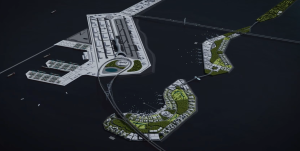
KUCHING: Alongside the new Kuching International Airport, the Sarawak government has plans to develop and integrated Kuching Low-Carbon Hub (KLCH) and a new deep-sea port in Tanjung Embang of the Kuching Division as part of the Tanjung Embang Master Plan.
Sarawak Premier, Tan Sri Abang Johari Tun Openg, states that new KLCH will be supported by natural gas from western Sarawak to provide reliable lower-carbon energy for various industries.
“We have established strategic partnerships with leading industry players, namely China Jiangsu International and Sumitomo Corp Japan,” he adds, highlighting the strong international traction that the KLCH plans have gained, including growing interest from Europe and other regions.

“With its prime location and shared infrastructures, Tanjung Embang is well positioned to become a competitive low-carbon gateway for trade, logistics and green industries”
The Tanjung Embang Master plan is set to facilitate connectivity, support trade and expand the state’s participation in regional and global supply chains. The new airport project will be developed as a future-ready aviation hub, with an initial capacity of 15 million passengers a year.
Meanwhile, the deep-sea port will handle larger cargo volumes, support industrial expansion and effectively connect Sarawak to global trade. The port is set to complement hubs such as Bintulu and Samalaju which house energy-intensive industries such as aluminium and ferroalloy smelting plants.
According to Abang Johari, the authorities are now in the process of finalising Tanjung Embang masterplan, with plans to begin physical and infrastructure developments as early as next year.
“We are developing the Sarawak AI Blueprint and roadmap towards 2030, exploring sovereign artificial intelligence infrastructure, building and AI talent pipeline and ensure that our policy and regulatory frameworks support innovation responsibly.”
The Sarawak government is reportedly also exploring innovations such as AI Grid networks and the integration of satellite-enabled capabilities, showing a deliberate shift towards more advance and scalable digital ecosystems.
Abang Johari states that a 405-hectare site has been identified and is set to be equipped with dedicated energy and water supplies to support data centre operations, AI computing and digital inter-connectivity nodes. He adds that this project will be implemented through a PPP approach, beginning with an initial phase covering 120 hectares.
He reveals that during his working visit to the United Kingdom and Ireland, the Sarawak delegation toured the K2 Strategic Data Centre Campus in Dublin, which is one of Europe’s leading hyperscale digital infrastructures.
The Harvard Business Review reports that the future economy will most likely be shaped by AI, automation and continuous technological adaptation. By 2030, more occupations are expected to be augmented by AI, driving higher rates of productivity, more efficient decision-making and the emergence of new industries.
“This reinforces the urgent need for Sarawak to increase investments in our digital ecosystem. Sarawak’s approach to AI advancement is guided by four key pillars: infrastructure, technology, talent and policy,” says Abang Johari.
The Premier disclosed that the state government aims to launch Sarawak’s first nanosatellite by 2030, giving Sarawak the capability to develop its own satellite system to obtain earth imagery, geolocation data and strategic information for planning, environmental monitoring and resource management.
He states that Sarawak is set to transition to clean energy, anchored on a strong renewable base with approximately 61% of Sarawak Energy Bhd coming from renewable sources, namely hydro.
“With the Baleh hydroelectric plan and upcoming large scale solar and low-carbon sources, we are expanding our supply capacity from 5.9 gigawatts to 10 by 2030.”
He adds that energy has become a strategic requirement for economic development, not only essential to support industries and attract investments but also to enhance long-term economic competitiveness.